What is an AI employee? A practical guide for small businesses
Start with a job you can describe, a result you can check and a person responsible for what happens next.
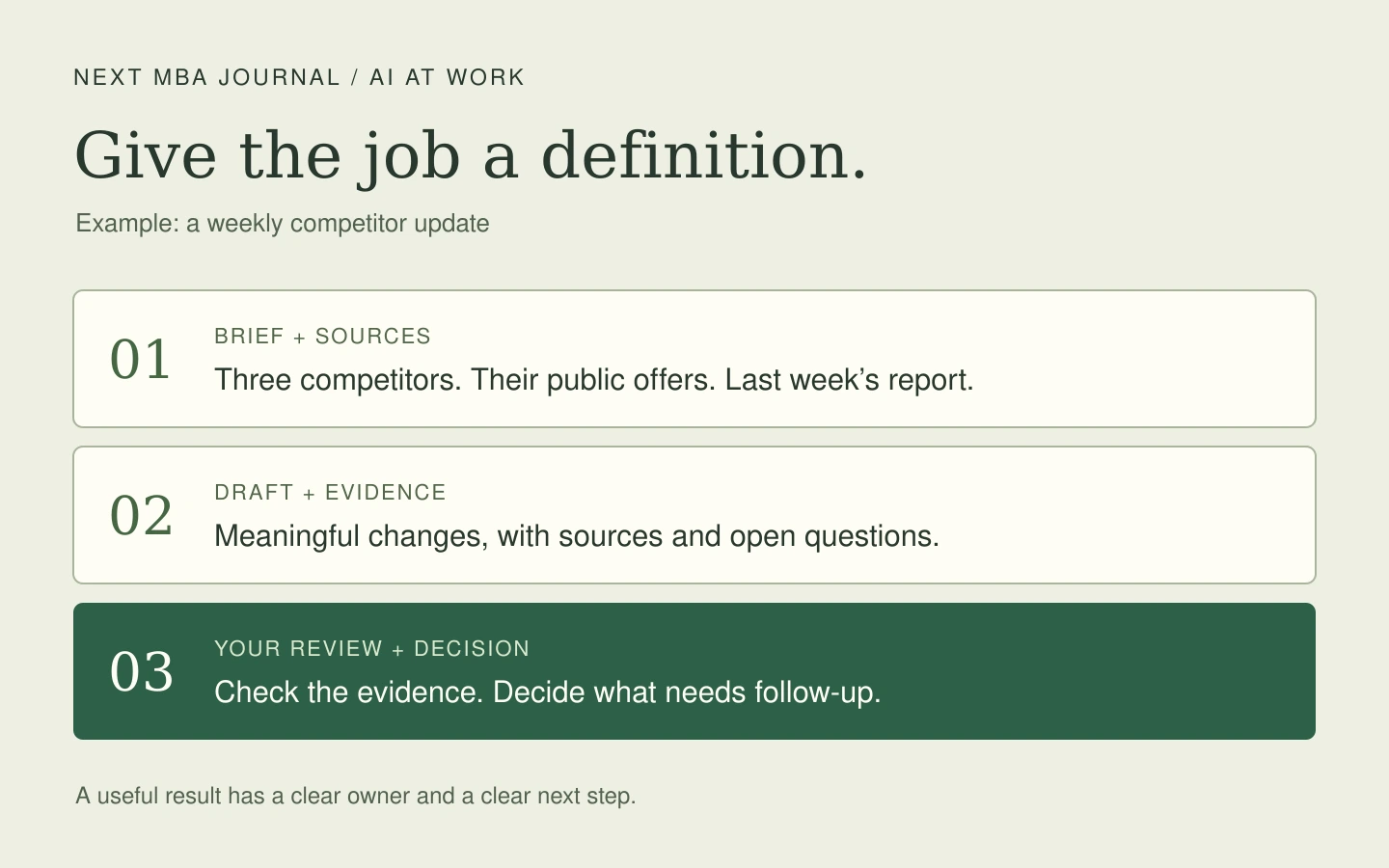
A Monday morning competitor update sounds like a small job. Until someone has to check the websites, separate real changes from noise and write a summary that is worth reading.
That is the sort of recurring task behind the appeal of an AI employee. The name is ambitious. The useful question is quite ordinary: can this software take responsibility for a defined piece of work, and can you tell whether it has done it properly?
What is an AI employee?
In this guide, an AI employee means AI software configured to help perform a defined business role or recurring set of tasks. It might research competitors, prepare customer replies or assemble a weekly report. What it can actually complete depends on the information, tools and permissions available to it.
The phrase is a product label, not a guarantee of autonomy. One service may only prepare drafts; another may also update a connected system. A job title such as “AI marketer” tells you less than a demonstration of the work it can finish.
There should still be a named person who owns the result. If a report contains an invented figure, calling its author an employee does not solve the problem. You need a way to trace the figure, correct the report and prevent the same mistake next time.
AI employee vs AI assistant vs AI agent
These labels overlap. For choosing a tool, it is more useful to compare how work begins, what happens between the request and the result, and where you are expected to step in.
| Label | What to look for |
|---|---|
| AI assistant | Helps with a request, such as explaining a document or preparing a draft. Check whether it has access to the information it needs. |
| Automation | Runs a defined process after a trigger. For example, an approved enquiry creates a task and notifies its owner. |
| AI agent | Can choose steps and use available tools while pursuing a goal. Check its stopping conditions and review points. |
| AI employee | Packages capabilities around a business role. Ask which outputs it owns, how often it works and who reviews the result. |
Anthropic’s engineering guide distinguishes workflows with predefined paths from agents that choose their own sequence of steps and tool use. It also recommends starting with the simplest approach that meets the need.1 The table above uses that distinction, alongside practical descriptions of the broader product labels.
If every enquiry should receive the same acknowledgement, a fixed automation may be enough. If a reply requires comparing an email with an order record and deciding which question remains unanswered, AI assistance may be useful. Neither job becomes better just because the software has a more impressive title.
Which tasks should a small business try first?
Look for work that recurs, has accessible inputs and produces something you can inspect. A first assignment should be small enough that you already know what a good result looks like. These are task examples, not promises that every AI product supports them.
Marketing research
Ask for a comparison of three competitors’ public offers, with a source and checked date for each observation. Specify whether you care about pricing, positioning or delivery terms. A useful report marks unavailable information as unknown instead of filling the gap with a guess.
Keep observations separate from recommendations. “Their homepage now leads with onboarding support” is something you can verify. “We should change our positioning” needs a separate argument.
Content preparation
Give the tool an approved product brief and ask for a draft aimed at one reader with one question. Require sources for factual claims and mark anything that needs confirmation. You remain responsible for the accuracy, voice and decision to publish.
The definition of done matters here. Ten generic drafts may create more editing work than one well-researched outline. Count material you can use, not the number of words produced.
Email preparation
A useful assignment might be to summarise an incoming message, identify the decision needed and prepare a reply using approved facts. The result should make missing context visible: perhaps the delivery date has not been confirmed, or the previous message referred to an attachment the tool cannot see.
Reading a mailbox, saving a draft and sending a message are different capabilities. Check which are supported and choose the access needed for the task you are actually testing.
Meeting follow-up
From notes you are permitted to use, ask for decisions, proposed actions, owners and due dates. Require the tool to distinguish an agreed commitment from a suggestion. If nobody accepted an action, the summary should say that the owner is unconfirmed.
A recurring report
Begin with a report you currently compile by hand. Specify the source data, reporting period and definitions. A lead, a qualified lead and a paying customer are not interchangeable. Compare the AI’s output with the same underlying records before changing your routine.
Give it a one-page job brief.
“Take care of marketing” leaves too many decisions unstated. The following brief makes a modest assignment concrete. You can reuse the structure for another task.
For recurring work, verify that the product can run on a schedule. Typing “every Monday” into a chat does not establish that a background task exists. Look for a saved schedule, an owner, a destination for the result and a way to pause it.
How do you know whether it is helping?
Run a small trial on work you understand. For example, choose ten comparable tasks and keep a record of what happened. Ten is a manageable starting batch, not statistical proof. Include a few awkward cases: a missing document, an ambiguous request and information that contradicts an older source.
| Record | Question to answer |
|---|---|
| Usable result | Did the output meet the brief? Record the specific correction if it did not. |
| Your time | How long did briefing, checking and fixing take compared with doing the task yourself? |
| Evidence | Could you trace important claims to the actual source? |
| Exceptions | Did the tool flag uncertainty or carry on with an unsupported assumption? |
| Cost | What did the completed, usable output cost after subscription and usage charges? |
Suppose a report takes you forty minutes to prepare manually. An AI draft still takes ten minutes to brief and twenty-five minutes to check and repair. In that fictional example, you have saved five minutes of personal work—not forty. You may still value the help, but you have a more honest basis for deciding.
Watch for work that quietly shifts back to you. If you must repeatedly restate the same constraints or hunt down missing sources, improve the brief or narrow the job before adding more tasks. Anthropic also notes the possibility of errors accumulating across autonomous steps and the need for testing and review boundaries.1
Questions to ask before subscribing
Can an AI employee work without supervision?
Some systems can complete bounded tasks without an intervention at every step. That does not make every assignment suitable for unattended work. Ask the provider to demonstrate what happens when information is missing, a connected service fails or the requested action exceeds its permissions.
Does it need access to all our business tools?
Start with the inputs required for one task. Public competitor research does not need your mailbox. Drafting from an approved brief does not need permission to publish. Expand access when you have a clear reason and can inspect what the tool does with it.
What should I check about data and pricing?
Read the service’s current terms for storage, deletion and use of submitted data. Check who can see shared work and how to disconnect an account. For pricing, ask about usage caps, connected services, extra charges and whether tasks stop or continue charging after a limit. These details vary by provider and plan.
Will it replace a person?
A useful trial can show that a defined task takes less work. It cannot, by itself, show that an entire role is covered. Relationships, competing priorities and decisions with incomplete context may still need substantial human attention. Evaluate the actual assignment before making a broader staffing decision.
How this fits LONED
LONED CMO is our AI employee for marketing work, with help for research, content and campaign planning. It sits alongside live learning and AI coaches in LONED+. The product and membership pages show what is available today.
We are also developing help for everyday work such as preparing email replies, including from spoken instructions. That is part of our direction, rather than a claim that every workflow described in this guide is already available.
Learning a skill and getting help with a task are different needs. Our guide to using AI for learning at work covers the first; the founder’s letter explains why we are bringing both into LONED.
For a first experiment, choose one recurring job that has been taking up too much of your week. Write down what a finished result should contain. Then see whether the tool can deliver it with less effort from you.
Source and editorial note
- Anthropic (2024). Building effective agents. Referenced for the distinction between workflows and agents, starting with simpler approaches, and evaluating autonomous steps.
The job brief, task examples and trial review sheet are editorial suggestions. They are not a product comparison or measured LONED customer outcomes. The term “AI employee” is used here as a practical description of a role-based tool.