AI sales roleplay: 7 scenarios to practise before your next call
A buyer asks for a discount. Your usual reply goes nowhere. That is a useful place to start practising.
You can know your product well and still lose your footing when a buyer says, “Your competitor is cheaper.” The difficult part is deciding what to ask next while the conversation is still moving.
AI sales roleplay gives you a place to rehearse that moment. Below are seven exercises with a buyer, a constraint and an observable goal. Use them with a voice-enabled AI tool that accepts a custom brief, or ask a colleague to play the other side. The situations and figures are fictional; adapt them to your business.
For a ready-to-use voice practice tool, explore LONED Sales Coach and its scenario-based conversations.
What is AI sales roleplay?
AI sales roleplay is a simulated sales conversation in which an AI plays a prospect, buyer or customer. You practise asking questions, explaining your offer and responding to objections. Depending on the tool, you can speak or type, read a transcript and request feedback afterwards.
The useful feature is repetition. You can return to the moment you rushed, made an unsupported promise or forgot to ask a question. But a simulation has limits: a model may agree too easily, misunderstand a response or give a generous score. A successful practice call does not predict a sale.
Roleplay itself is familiar sales-training territory. Salesforce’s objection-handling workbook includes paired conversations followed by a debrief.1 AI changes the availability of a practice partner. You still need to decide what the exercise is meant to teach.
Give the buyer something real to care about.
“Be a difficult customer” usually produces a vague argument. A better brief explains why the buyer might hesitate: an implementation deadline, a disappointing previous supplier, a budget ceiling or an internal approval process.
Specify what you are allowed to offer, too. If the exercise lets you promise any discount, delivery date or feature, there is very little to practise. Use invented details and keep confidential customer information out of the brief.
- BUYERWho is deciding?
A role, a business problem and a reason to hesitate.
- OFFERWhat can you deliver?
A defined service, price and realistic timeframe.
- BOUNDARYWhat cannot change?
A minimum fee, delivery limit or feature you do not offer.
- OUTCOMEWhat counts as progress?
A useful answer, an agreed next step or a clear decision to stop.
Seven AI sales roleplay scenarios
Choose the scenario closest to your next real conversation. You do not need to work through all seven in one sitting.
1. The cold call with very little time
Brief: You sell maintenance scheduling software. The operations manager says they have thirty seconds and already use a spreadsheet. Their team has recently missed two service appointments, but they will only mention that if you ask a relevant question.
Your goal: Establish whether scheduling is worth discussing and, if it is, agree a short follow-up. Ask the AI to end the call if you ignore a clear refusal. In the review, look at whether your opening explained why you called before launching into features.
2. The discovery call where the brief keeps changing
Brief: A founder wants “more leads” from a marketing agency. They also mention slow follow-up, poor-quality enquiries and a sales team with no spare capacity. They have not decided which problem matters most.
Your goal: Agree on one priority and what would count as improvement before recommending work. Ask the AI to introduce the extra problems gradually. Afterwards, check whether you summarised the founder’s answers accurately or simply waited for an opening to pitch.
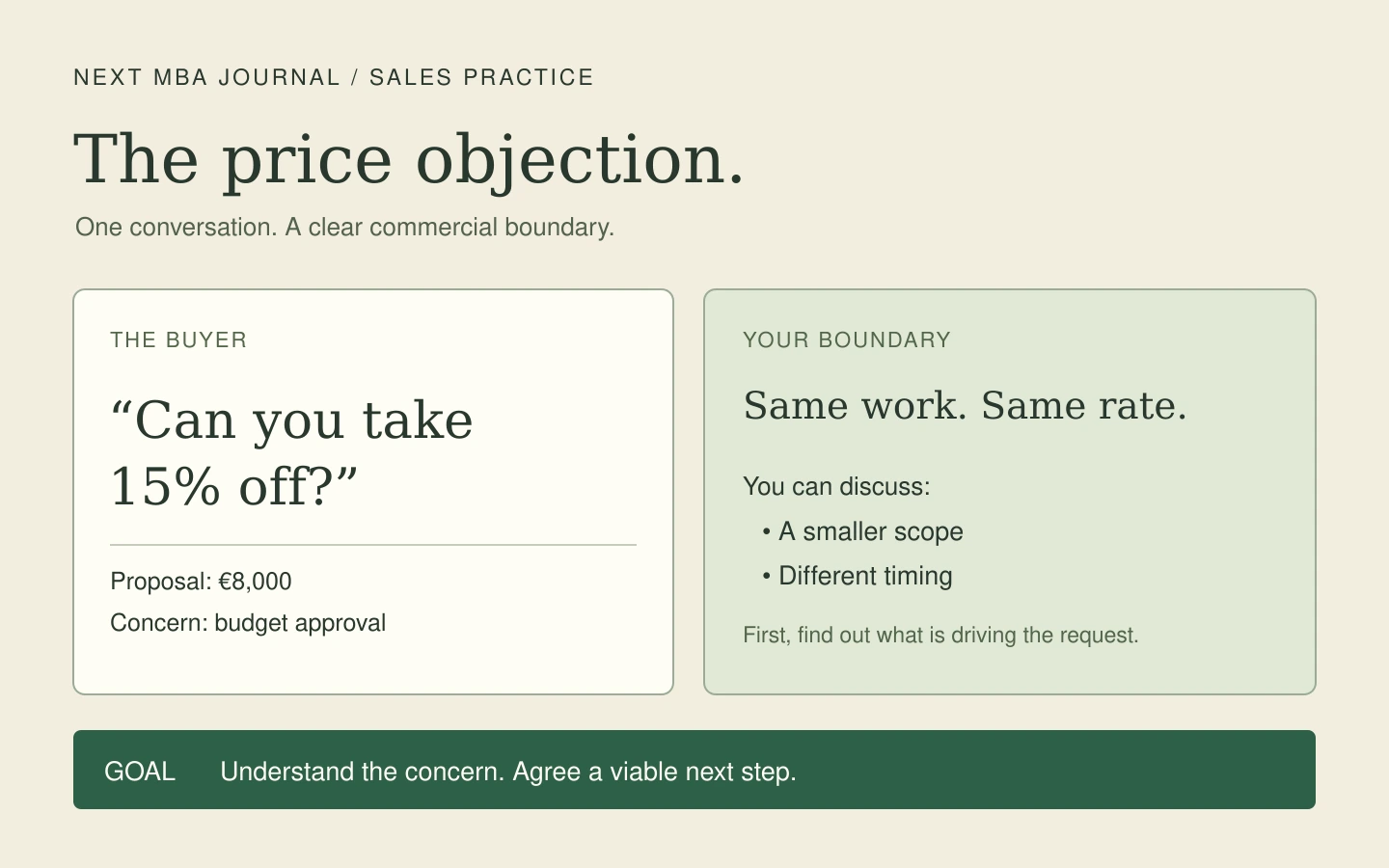
3. The price objection you cannot solve with a discount
Brief: Your proposal is €8,000. The buyer asks for 15% off. You can reduce deliverables or adjust timing, but you cannot lower your rate for the same work. The buyer worries about spending the budget before a new project is approved.
Your goal: Understand the concern, then discuss an option that fits your limits. A useful question might be: “Which part of the commitment is hardest to make today?” Listen to the answer before proposing a smaller scope. The practice fails if you quietly promise the full package for less.
4. The competitor who appears to offer the same thing
Brief: Another provider is 20% cheaper. Their offer includes a narrower support window, but the buyer does not yet know whether support matters to their team. You have no reliable information about the competitor beyond the written proposal.
Your goal: Find the buyer’s decision criteria and compare what is actually included. Have the AI challenge vague claims such as “our quality is better”. Review whether you explained a relevant difference without inventing weaknesses in the other company.
5. The enthusiastic contact who cannot approve the purchase
Brief: A department manager likes your training proposal. Finance controls the budget and the director needs evidence that the team can attend. Your contact does not want to look unprepared in front of either person.
Your goal: Learn how the decision will be made and agree what would help your contact make the case. A useful outcome could be a short summary for the director and a proposed meeting with finance. “They loved the demo” is not enough information to plan the next step.
6. The renewal after a disappointing first year
Brief: The customer is considering cancellation. They bought twenty software seats, but only eight people use them. They feel the onboarding was rushed. You cannot erase the existing invoice or promise a product change.
Your goal: Understand the gap between what they expected and what happened. Explore whether a smaller package or a specific support plan would help. Ask the AI to remain unconvinced until you address the actual concern. A cancellation can be an honest outcome; do not reward yourself for pressuring someone to stay.
7. The final negotiation with an impossible deadline
Brief: A buyer will sign a €12,000 project if you deliver everything in ten days. Your team needs fifteen. A limited first phase could be ready in ten days, but only if the customer provides materials by tomorrow.
Your goal: Agree a feasible first phase, responsibilities and dates—or explain why the deal cannot work. Have the AI ask what happens if the materials arrive late. Review whether your final summary matches what both sides actually agreed.
A prompt you can reuse
Paste one of the briefs above after this instruction. It is intended for a tool that accepts open-ended roleplay prompts; dedicated training apps may provide their own scenario controls.
Review what happened, not how confident you sounded.
Salesforce’s guidance on objections puts discovery and open questions before a response to the concern.2 That is a useful starting point for a review: did you learn something that changed your answer?
| Look for | Evidence in the conversation |
|---|---|
| Understanding | You identified the concern and checked that you understood it correctly. |
| Relevance | Your response addressed that concern using facts from the brief. |
| Listening | The buyer’s answer changed your next question or proposal. |
| Commercial limits | You stayed within the price, scope and delivery boundaries. |
| Next step | Both sides understood what would happen next, or why the discussion should stop. |
Mark each item “shown”, “partly shown” or “not shown”, and attach a line from the transcript. This is an editorial review aid, not a validated assessment. If the AI praises a question you never asked, correct the review.
Choose one exchange to repeat. Then change one condition—the deadline, the budget or the person approving the purchase. It helps reveal whether you understood the situation or learned a reply by heart. For a broader practice routine, see how to use AI for learning at work.
Common questions
Can I practise sales roleplay on my own?
Yes. A text-based AI can take the buyer’s role; a voice tool lets you rehearse speaking and responding in the moment. Give either one a clear brief and review its feedback critically. You can also repeat the exercise with a colleague to hear a different reaction.
How long should a session last?
Long enough to reach the difficult exchange and try it again. As a starting point, allow five minutes for the conversation and another five for review and a second attempt. Shorten the scenario if you never reach the part you wanted to practise.
Does AI sales training replace a manager or coach?
A manager who knows your customers can spot problems the simulation misses, including whether you are pursuing the right opportunity. Use AI for accessible practice, and bring the difficult or surprising exchanges to a human coach. Live teaching and self-paced learning can serve different parts of that process.
Where does LONED Sales Coach fit?
LONED Sales Coach offers spoken practice with simulated sales situations and feedback. It is part of LONED+. The exercises in this article are adaptable editorial examples, rather than a claim that every tool includes these exact seven scenarios.
Sources and editorial note
- Salesforce (2024). Objection Handling Template, including its team roleplay exercise.
- Marcus Chan, Salesforce. 7 Winning Steps for Effective Objection Handling.
The seven briefs, reusable prompt and scorecard were prepared for this article. They are fictional training examples, not customer results or evidence of a particular improvement in sales.